The first quarter of 2026 showed HSA deposit rates unchanged across balance tiers, with the exception being the $1,000 threshold, which decreased 0.01%. The $1,000 balance declined from 0.46% to 0.45%, while the $10,000 and $25,000 balance tiers remained constant at 0.55% and 0.60%, respectively. For three consecutive quarters, the rates for $10,000 and $25,000 tiers have had no movement demonstrating stability for the higher tier balances. However, for the $1,000 tier, the rate decreased by 0.01% after a rate increase over the past three quarters.
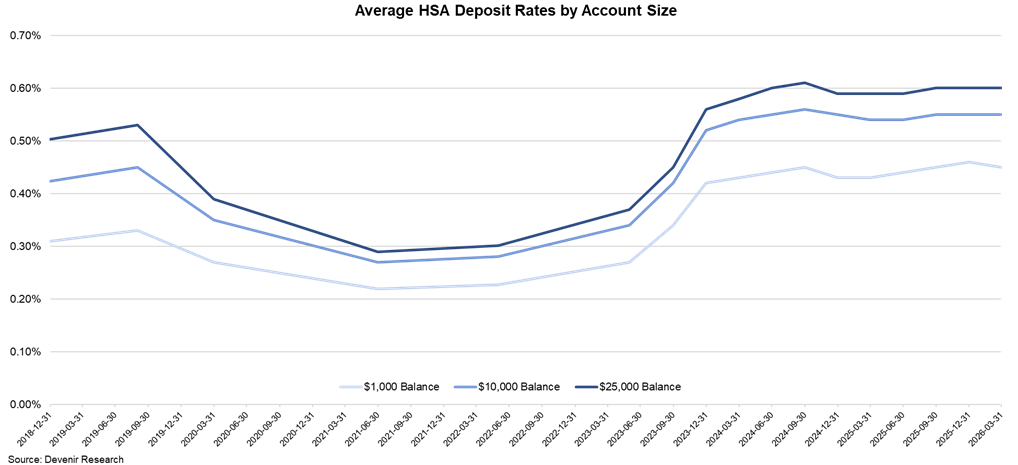
Last quarter, the Fed held rates steady. The Effective Federal Funds Rate (EFFR) remains at 3.64%1, which is lower than the long-term average of 4.60%2. It is still elevated compared to before the Federal Reserve’s most recent rate hiking cycle began. HSA deposit rates also remained steady. The difference between the rates offered for $1,000 and $25,000 tier balances is 15 basis points. This spread has appeared in three of the last four quarters.
HSA providers continue to monitor their deposit rates for several reasons — attracting new account holders, staying competitive for existing account holders, fluctuations in funding costs, and evolving Federal policies. For employers and account holders, this means monitoring to rate updates more closely, particularly as economic conditions remain fluid.
Note: The above reflects Devenir’s summary of publicly available data. We encourage readers to confirm specific rates with individual HSA providers, as offerings can differ significantly and change without notice.
References
- Federal Reserve Bank of New York, Effective Federal Funds Rate [EFFR], retrieved from FRED, Federal Reserve Bank of St. Louis; https://fred.stlouisfed.org/series/EFFR, April 1, 2026
- YCharts, April 1, 2026, Effective Federal Funds Rate (I:EFFRND), YCharts, https://ycharts.com/indicators/effective_federal_funds_rate